
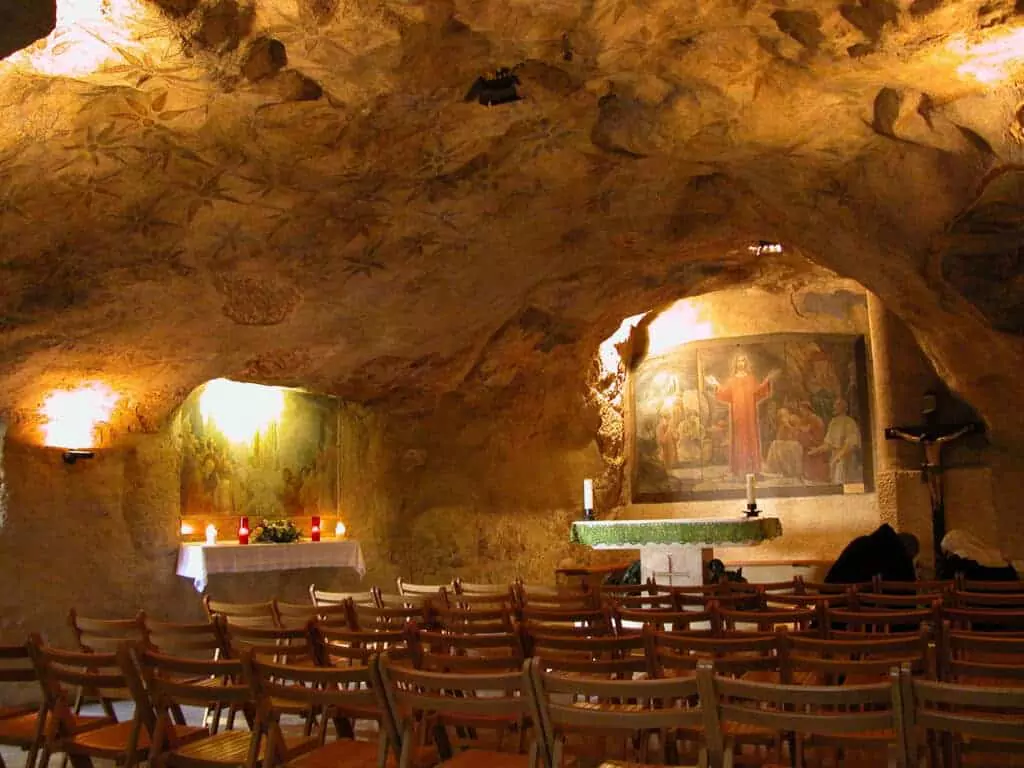
Jesus’ Agony at Gethsemane
Late Thursday
The Gospels say Jesus and the 11 left the room of the Last Supper and went across the Kidron Valley to a place called “Gethsemane.” Surprisingly there is no reference to the expression “Garden of Gethsemane.” It is just Gethsemane, which means “olive press.” A cave at the foot of the Mount of Olives held an ancient olive press. In that cave, Jesus had gathered on the nights before his arrest on Thursday evening. People have read so much genuine angst and emotional pain in that account. Even the Book of Hebrews referred to the Savior’s emotional agony as a time when he “offered up prayers and supplications, with loud cries and tears, to him who was able to save him from death, and he was heard because of his reverence” (Heb. 5:7)
Mark alone records a strange event at the end of this gut-wrenching drama at Gethsemane. When his disciples fled, a young man watched in the bushes who also fled “naked” as the authorities grabbed his garment. (14:50–51). This young man’s lack of a name has led to many suggestions about his identity. The best idea is that it was young Mark himself, recording a self-effacing signature to his Gospel.
Markan authorship of the Gospel supports this theory, as does the fact that the early church met in the house of John Mark’s mother (Acts 12). There’s also the probability that her home was the location of the Last Supper. I imagine the young man may have been watching the Passover Seder from his room and then rushed out partially clothed as they left for Gethsemane. This is the best suggestion, along with “protective anonymity” as a motive for the Gospel’s silence about his identity. What else does Mark want us to see in this incident in the context of his whole Gospel? Certainly, he meant his fleeing (14:50–51) to represent the larger fleeing of the disciples just mentioned (14:49). But is there more?
Within Mark, there is another possible connection with this strange event. In Mark 14:51, this young man wore a garment. Later in the empty tomb description (16:5), a young man is clothed in a robe. Does Mark intend this to contrast the fear and naked abandonment of the young man in Gethsemane with the victorious and clothed announcement of another young man in the tomb? The fact that Mark alone calls that angel in the tomb a “young man” certainly makes his association with these two incidents a real possibility.
Let us not be so distracted by this odd event that we lose sight of Jesus’ suffering, which was not limited to his later beatings and pain on the cross. The severe inner emotional pain began here in Gethsemane, under some lovely olive trees.
Prayer for Reflection:
“Lord Jesus, as I naturally shrink from the tasks I must do, I am reminded that in your true humanity, you did not want to follow that path determined by your Father. I need the same grace given to you to face the hard path ahead. Help me by your grace (Heb 4:16) in my own time of need not to seek my will but the will of my Father, even if it means a hard road ahead. Lord Jesus, your grace is sufficient for me.”
All Devotionals:
8 Daily Devotionals from Palm Sunday to Easter
©2023 William Varner. Used with permission.
About The Author

William Varner
William Varner teaches at The Master’s University and is a pastor/teacher at Grace Baptist Church in Santa Clarita, Calif. He has written twenty books, including Passionate About the Passion Week: A Fresh Look at Jesus’ Last Days (Fontes Press, 2020).